Lids off
Orange sticks or Toyota bricks? New vs refurbished hybrid batteries
Both fit the same space in your car. One is built from used Toyota modules, the other from cells that have never been used. We took the lids off both, ran the numbers, and answered the questions people ask us every week.
Two Prius owners in Phoenix see the same red warning triangle on the same morning.
The first wants it fixed for as little as possible, and picks the cheapest battery. The second asks a different question: what will this cost me per year?
A 1-year refurbished pack, fitted, is $1,500. A new one is $2,500 with a 4-year warranty. Buying the same 4 years of warranty cover with refurbished packs would cost $6,000. Per year covered, the new pack is the cheaper battery by a long way, and you only take the car in once.
That's the short answer. The long one is more interesting, and it starts with what's actually under the lid.
Lids off, side by side
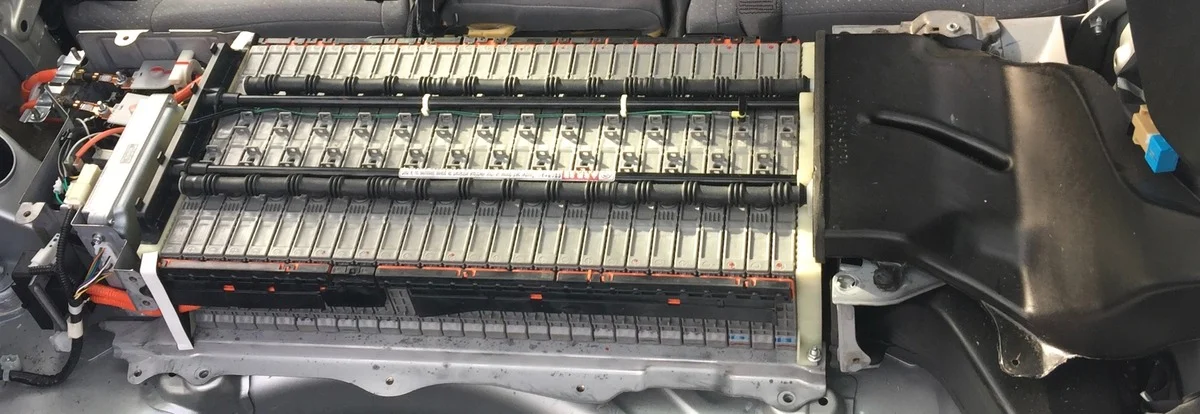
Refurbished
Toyota bricks, second time around
- 28 flat grey Toyota modules, the original design
- Used modules from other cars, tested and matched
- Every module already 10+ years old
- 1-year warranty at most
- From $750 fitted on a Prius
Photo: “Prius 2005 Hybrid battery” by Ww2censor, a 2005 Prius pack refitted after failed modules were replaced. CC BY-SA 4.0, cropped.
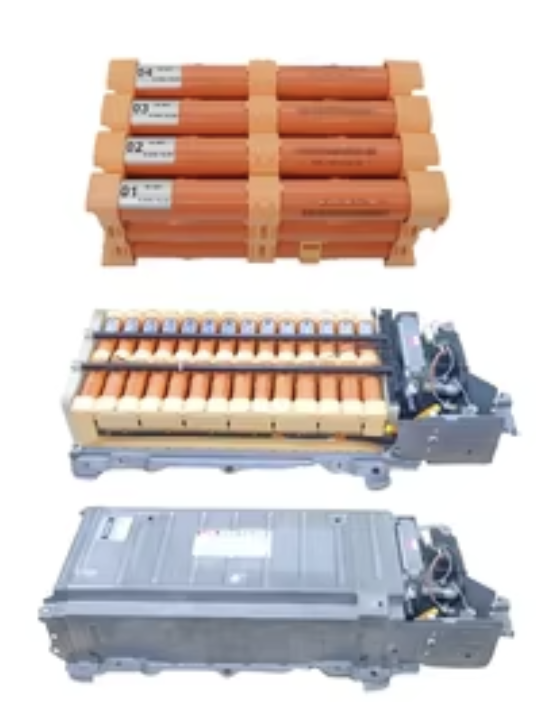
New aftermarket · our pick
Orange sticks, never used
- Brand-new round (cylindrical) cells, the orange sticks
- Every cell new and the same age
- Fits the original space; uses the car's own battery computer and fan
- 4-year warranty, four times refurbished
- $2,500 fitted on a Prius, $625 a year
Top: the new cells. Middle: fitted in the battery case. Bottom: closed and ready to install.
Part 1
A hybrid battery is 168 small batteries in a row
Take the 2004–2015 Toyota Prius. Its battery holds 28 modules, each made of six cells of 1.2 volts: 168 cells wired one after another, adding up to 201.6 volts and about 6.5 amp-hours. Those are Toyota's own figures.
Picture 168 flashlight batteries taped end to end. Every bit of power the car stores or uses passes through every one of them. Hold on to that picture, because it explains why batteries die.
Part 2
Why they die: the weakest cell wins
In a chain, the same current runs through every cell. When one cell has worn more than the rest, it runs empty first and fills up first, and the car has to stop there. So the whole pack can only do what its weakest cell can do.
A worn cell also fights the current harder (its internal resistance goes up), and the heat a cell makes rises with that resistance: twice the resistance, twice the heat at the same current. The weakest cell runs hottest, the heat wears it faster, and the slide speeds up.
The car is watching. The Prius battery computer measures the pack in 14 blocks, and when one drifts too far from the others it lights the warning and stores a code like P0A80, “replace hybrid battery pack”. By then one or two blocks are usually far worse than the rest.
Part 3
What refurbished really means
A refurbished pack keeps Toyota's 28 bricks but swaps the worn ones for used modules that test well. Done properly, every module is charged and drained on a bench machine to measure its real capacity, checked for internal resistance, grouped with modules that measured close to it, and the finished pack is balanced and load-tested. Here's how we do it.
It works, and it's an honest low-cost repair. But it has a ceiling: the last 2004–2015 Prius was built in 2015, so every module in a refurbished pack has already spent ten years or more in a car. Testing finds the good ones. It can't make them young again. Matched modules start close together and then age at their own pace, which is why refurbished packs carry short warranties.
Part 4
What's inside the orange pack
The new pack does the same job with all-new parts. In place of Toyota's flat bricks it uses new round cells, the orange sticks, grouped to give the same voltage as the original. It fits the original space and plugs into the car's own battery computer and cooling fan, so the car sees the battery it expects.
The big difference is the starting line. In a new pack every cell begins at zero, together. There's no module that spent a decade of Arizona summers in someone else's car, no hidden tired cell already running hot, and nothing to match because nothing has aged yet.
“Aftermarket packs don't last.”
You'll read that on forums. Our experience: no new pack we've fitted has failed since we started selling them, and every one carries a 4 years warranty from us, not from a website you can't call.
Part 5
The heat question, answered honestly
Heat is what really kills these batteries, and the battery makers say so plainly. Panasonic's nickel-metal hydride handbook puts the best charging efficiency at roughly 10 to 30 °C (50 to 86 °F) and shows cells losing charge faster as they get hotter. Energizer's handbook says heat cuts how well a cell takes a charge and how many cycles it lasts. A U.S. National Renewable Energy Laboratory study of Prius modules found what matters is how hot the pack peaks and how evenly the heat spreads.
The Prius cools its battery with a fan that pulls cabin air through the pack. In a Phoenix July that air is hot before it even gets there, and a parked car soaks in heat with the fan off.
Whichever pack you choose, keep the air path clear. A clogged intake filter starves the fan and cooks the cells; our annual battery service cleans it and checks the fan.
Part 6
The money, per year
Toyota Prius prices from our price table, fitted at our shop (battery plus the $250 fitting). Mobile install is $250 more.
| Option | Warranty | Fitted | Per year of warranty |
|---|---|---|---|
| New aftermarketBest value | 4 years | $2,500 | $625 |
| Refurbished | 1 year | $1,500 | $1,500 |
| Refurbished | 3 months | $750 | $3,000 |
Driving for work? Taxi, rideshare and delivery cars are covered too: 48 months or 80,000 miles on a new battery, against 12 months or 20,000 miles on a refurbished one. See the warranty.
Part 7
So which should you pick?
| If you… | Pick |
|---|---|
| …plan to keep the car three years or more | New |
| …drive for rideshare, delivery or taxi | New |
| …want to fix it once and stop thinking about it | New |
| …are selling the car in the next few months | Refurbished |
| …need it running this week for the least money | Refurbished |
Before you buy any battery: make sure it's the battery
A red triangle doesn't always mean a dead pack. A weak 12-volt battery, a clogged battery fan or a failed inverter coolant pump can all set warnings that look like it. We test the pack block by block first, so you never pay for a battery you didn't need. About our battery test.
New aftermarket prices for other cars
- Toyota Prius v · 2012–2017$2,250
- Toyota Prius c · 2012–2019$2,250
- Toyota Prius · 2016–2022$2,250
- Lexus CT 200h · 2011–2017$2,250
- Toyota Camry Hybrid · 2007–2017$2,850
- Toyota Avalon Hybrid · 2013–2018$2,850
- Lexus ES 300h · 2013–2018$2,850
- Toyota RAV4 Hybrid · 2016–2018$2,850
Not listed? Pick your car and see every pack we sell for it.
Questions people ask
Is a new aftermarket battery the same as a Toyota battery from the dealer?
Has a new aftermarket battery you've fitted ever failed?
How long does it take to fit a new hybrid battery?
Is a refurbished battery a bad choice?
What does the 4-year warranty cover?
Not sure what your hybrid needs? We'll work it out with you.
We come to you, test the pack, the 12V and the cooling, and you get a written quote before anything is decided. No obligation.