Camry Hybrid Losing Power on Freeway Hills: What's Usually Behind It
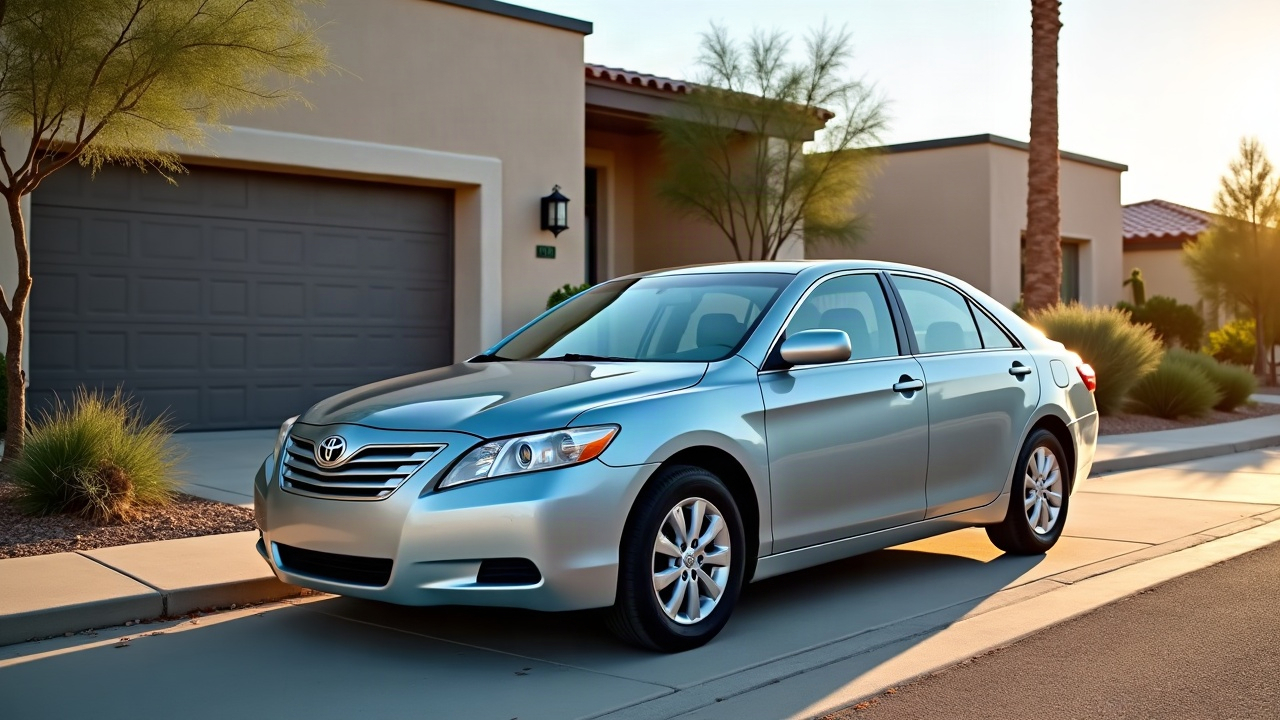
Camry Hybrids usually lose hill power 1–2 years before any code sets. Here's why grades expose pack wear first, and how we confirm it.
If your Camry Hybrid pulls fine on flat pavement but runs out of breath climbing a grade, the hybrid pack is the first thing Healthy Hybrid would check — capacity loss shows up on sustained hills 1 to 2 years before any dash light appears. On a 12- to 18-year-old Camry Hybrid in Arizona, a pack that still passes a parking-lot scan can be almost useless at 70 mph up a 6% grade.
That gap between "drives fine" and "can't climb" is the single most common reason Camry Hybrid owners call us with no warning light on.
Why does it only happen on hills?
On flat ground your hybrid system barely leans on the battery. The engine does nearly all the work, the pack contributes short bursts at part throttle, and regen refills it at every off-ramp and stoplight. A pack with half its original capacity can fake that indefinitely.
A sustained climb is a completely different demand. You're asking the pack for continuous high-amp discharge for 30 seconds, a minute, sometimes five minutes, with no regen coming back. That's the one condition that exposes two things a light-load test cannot:
- Reduced usable capacity. A worn pack runs out of charge partway up. The state-of-charge bars drop fast, the hybrid ECU cuts assist to protect the pack, and the engine is suddenly carrying the car alone.
- Weak individual blocks. The Camry Hybrid pack is a series string of NiMH modules. Under heavy load, a degraded block's voltage sags far below its neighbours. The ECU watches the lowest block, not the average, so one bad module limits the whole car.
What you feel is the engine screaming at high RPM while the car slows anyway. Owners describe it as "flooring it and nothing happens" or "it downshifts and gives up."
Where this shows up in Arizona
This is a local problem more than a national one, for two reasons.
First, heat. NiMH cells age faster at high temperature, and a pack that spends summers parked in 110°F ambient with cabin temps far higher loses capacity years earlier than the same pack in a mild climate. Ten-year-old is a realistic wear point here; elsewhere the same pack might be fine at fifteen.
Second, our grades. The Valley is flat, so a weak pack can hide for a long time. Then you take I-17 north toward Sunset Point, or US-60 up past Gold Canyon, or the climb out toward Yarnell, and the car asks the battery for something it hasn't been asked for in months. A lot of packs fail their first real test on a weekend trip, not on the commute.
Heat also interacts with the cooling path. The Camry Hybrid pack is air-cooled through a cabin intake, usually behind the rear seat. If that intake is blocked by luggage, a car seat, or pet hair, cell temperatures on a long climb climb further and the ECU derates assist even sooner. Keeping that vent clear costs nothing and matters here.
How do I know it's the battery and not something else?
Reduced power on grades has a handful of causes. They feel similar from the driver's seat and separate cleanly on a scan tool.
| What you notice | Likely cause | How it's confirmed |
|---|---|---|
| Assist fades on long climbs, SOC bars drop fast then bounce back at the bottom | Hybrid pack capacity loss | Block voltage spread under load, internal resistance per module |
| Sudden full power loss with red triangle and a stored code | Failed block or pack fault | P0A80 or P3011–P3024 block-weak codes |
| Power drops after several minutes at speed in summer heat, recovers when cool | Battery cooling restriction or inverter cooling | Pack inlet/outlet temps, fan duty, P0A93 |
| Sluggish everywhere, not just hills, plus rough idle | Engine side — intake, injectors, spark, EGR | Fuel trims, misfire counters, engine data |
| Slow crank-to-ready, odd electrical behaviour, dash flicker | 12V battery | 12V load test versus hybrid pack test |
The measurement that settles it is block voltage under load. We read every module pair while the pack is discharging, and we look at the spread between the strongest and weakest block. A healthy pack stays tight. A pack that's done sees one or more blocks collapse the moment current goes up, then snap back when the load is removed. That signature is unmistakable, and it appears well before a code sets.
We do that on your driveway. Our hybrid battery diagnostic comes to you, and you get the actual block numbers rather than a verdict. Contact us and we'll let you know the diagnostic fee before we schedule.
Which generation of Camry Hybrid are you driving?
It matters for what to expect:
- 2007–2011 (AHV40). Oldest NiMH packs, most heat exposure. Almost all hill-power complaints on these cars are pack capacity.
- 2012–2017 (XV50). The bulk of what we see now. Many are hitting the wear point right on schedule for Arizona heat.
- 2018 and newer (XV70). Still often inside Toyota's own hybrid component coverage — 8 years/100,000 miles in most states, 10 years/150,000 miles on newer models in some. That's the manufacturer's warranty, not ours, and it's worth checking your in-service date with a Toyota dealer before you pay anyone.
Model-specific detail on packs, codes and symptoms lives on our Toyota Camry Hybrid page.
What does the fix cost?
These are set installed prices for the Toyota Prius. A Camry Hybrid is priced per car, so we quote yours specifically after the diagnostic.
| Option | Installed at our shop | If we come to you | Warranty |
|---|---|---|---|
| New aftermarket battery | $2,250 | $2,500 | 4 years |
| Rebuilt — 1-year | $1,250 | $1,500 | 1 year |
| Rebuilt — 3-month | $600 | $850 | 3 months |
They include $250 to fit the pack at our shop, and mobile install at your home or work is a further $250 again. Most installs take about 30 minutes. New nickel-plated bus bars with stainless nuts are $99 if you want the connections renewed at the same time. Full detail is on our pricing page and the terms are laid out on the warranty page — labour is included for the full term, coverage isn't prorated, and it stays with the car if you sell it.
If the pack is worn but not failed, reconditioning is sometimes the right call, and annual service can hold a marginal pack steady in this climate. The diagnostic tells us which conversation we're having.
Book a mobile diagnostic and we'll come read your pack where the car sits, or call Healthy Hybrid at 833-995-7966.