Will a Hybrid Battery Really Last 200,000 Miles?
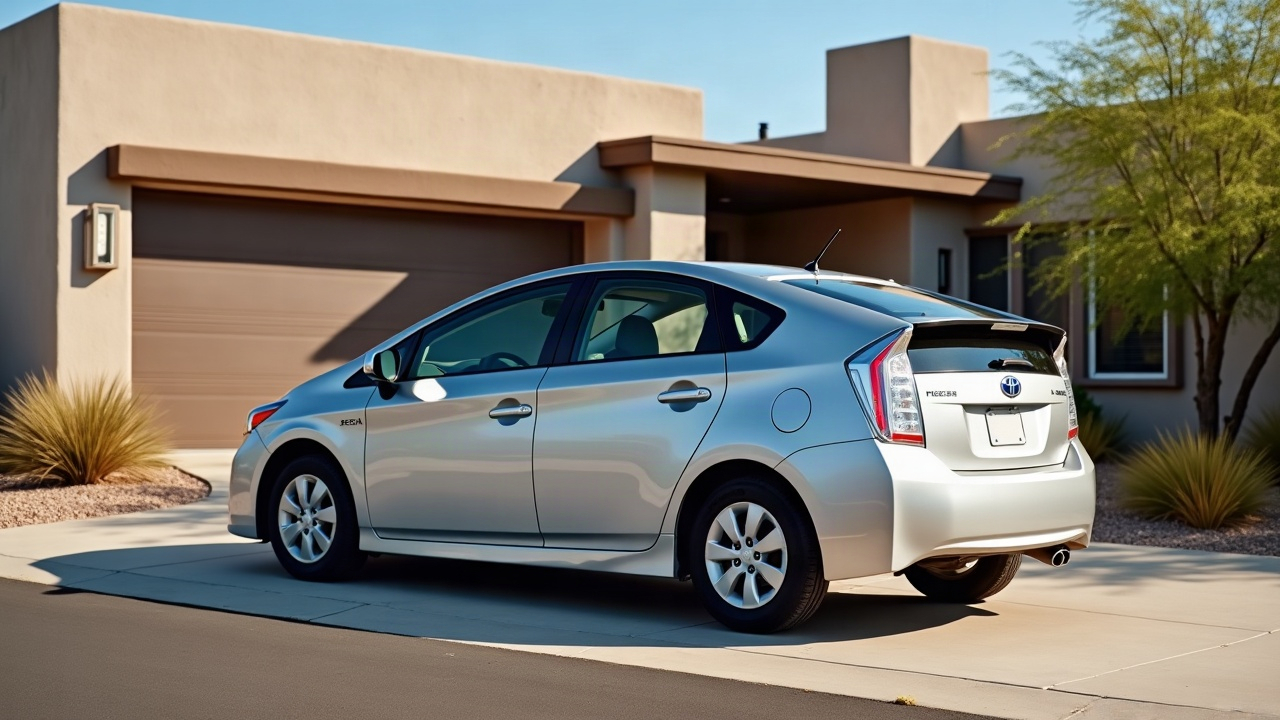
Some hybrid packs do hit 200,000 miles. In Arizona heat, most don't — and here's what actually decides which group your car falls into.
Yes, some hybrid batteries reach 200,000 miles and a few go past it — but in Arizona, an original NiMH pack more commonly starts showing real weakness somewhere between 120,000 and 180,000 miles. At Healthy Hybrid we'd say the odometer is the least useful number in that sentence. What actually decides pack life is heat exposure, how deeply the pack cycles, and how evenly its blocks age relative to each other.
That is why two 2012 Priuses with 165,000 miles each can be in completely different condition — one still pulling strong assist on the freeway, the other throwing a code in a Fry's parking lot.
Why does mileage predict so little?
A nickel-metal-hydride hybrid pack is not a wear item like a brake pad, where friction accumulates in proportion to use. It is a chemical system that degrades on two clocks at once: a cycle clock and a calendar clock.
The cycle clock runs when the pack charges and discharges. The calendar clock runs all the time, including while the car sits in a driveway in July. Heat accelerates the calendar clock dramatically. A pack parked outside in Phoenix is aging even on the days you never drive it.
So a car with 200,000 highway miles from a mild coastal climate can easily have a healthier pack than a Valley car with 110,000 stop-and-go miles. Same chemistry, very different history.
What raises and lowers the number?
| Factor | Pushes pack life up | Pushes pack life down |
|---|---|---|
| Climate | Mild summers, garage parking | Sustained 110°F+ ambient, outdoor parking, dark interior colours |
| Cooling intake | Clean filter and fan, unobstructed vent | Vent blocked by cargo, pet hair, dust, or a car seat base |
| Driving pattern | Steady 20+ minute trips | Short 5-minute errands where the pack cycles hard and never settles |
| Terrain | Flat valley driving | Repeated long grades that force deep discharge then hard regen |
| Storage | Driven regularly | Sat unused for months at a partial state of charge |
| Block balance | Blocks aging evenly | One or two weak blocks dragging the whole string |
| Maintenance | Fan cleaning, periodic reconditioning | Never opened, never balanced |
Notice that four of those seven have nothing to do with how far you've driven.
How much does Arizona heat actually change it?
More than any other single variable. NiMH cells lose capacity faster at elevated temperature, and the pack's own operation adds heat on top of ambient. Toyota and Lexus hybrids handle this with a cabin-air cooling fan that pulls conditioned air across the modules — which works well, right up until the intake gets restricted.
In a Phoenix summer, that fan is doing real work every day. Dust and pet hair build up in the filter and duct. Airflow drops. Module temperatures climb. The blocks nearest the hot end of the pack age faster than the rest, and the imbalance grows.
That imbalance is the actual failure mechanism most owners hit. The pack does not die all at once. One block sags under load, the battery ECU sees the spread between the strongest and weakest blocks widen past its threshold, and you get P0A80 or one of the P3011 through P3024 block-weak codes. The other 26 blocks may still be perfectly serviceable.
This is also why cleaning the cooling fan matters far more here than it does in Oregon. It gets dealt with at install, and on a car that still has a healthy pack keeping that intake clear is straightforward preventive work you can do yourself.
Can a pack be "alive" and still be costing me money?
Yes, and this is the part the 200,000-mile talking point skips entirely.
There is a wide zone between "working normally" and "triggered a code." In that zone, the pack still moves the car, still passes a scan with no stored faults, and still gets described as fine. But its usable capacity has shrunk. The engine runs more often to make up the difference. The state-of-charge bar swings up and down instead of hovering in the middle.
A third-generation Prius that once returned 48 MPG and now returns 36 has not failed. It is just quietly charging you the difference every time you fill up. Over 12,000 miles a year at Arizona gas prices, that gap is real money — and it compounds while you wait for a light that may not come for another year.
So "has it failed?" and "is it still worth running as-is?" are two separate questions. Answer both before you make a decision.
How do I find out where my pack actually is?
Mileage won't tell you and a generic code reader won't either. What tells you is a block-level test: reading each block's voltage under load and at rest, and looking at the spread between the strongest and weakest.
A tight spread means the pack is aging evenly and probably has real life left, regardless of what the odometer says. A wide spread means you are close to the edge even if nothing has illuminated yet. Our hybrid battery diagnostic does exactly that, and it comes to your driveway — including when the answer turns out to be that your pack is fine and the fuel economy drop is coming from somewhere else. Contact us and we'll let you know the diagnostic fee before we schedule.
If the pack is still healthy but drifting, annual reconditioning can rebalance blocks and buy real time. If it is genuinely done, our battery prices are set, not estimates: $600 installed at our shop ($850 if we come to you) with a 3-month warranty, $1,250 ($1,500) with a 1-year warranty, or $2,250 ($2,500) for a new aftermarket pack with a 4-year warranty. Those are installed prices for the Toyota Prius. Every other vehicle is priced per car — two options, new or refurbished — so contact us and we'll let you know what yours comes to. Most installs take about 30 minutes.
What should I take from the 200,000 number?
Treat it as proof of what's possible, not as a schedule. Packs that get there are usually garage-parked, driven in longer stretches, kept cool, and looked at before the light comes on. Packs that stop at 130,000 usually sat in the sun, ran a clogged cooling fan for years, and were never tested until they threw a code.
You can find out which one you're driving today. Call Healthy Hybrid at 833-995-7966 or book the mobile diagnostic — we come to you anywhere in the Phoenix metro. Contact us and we'll let you know the diagnostic fee before we schedule.